
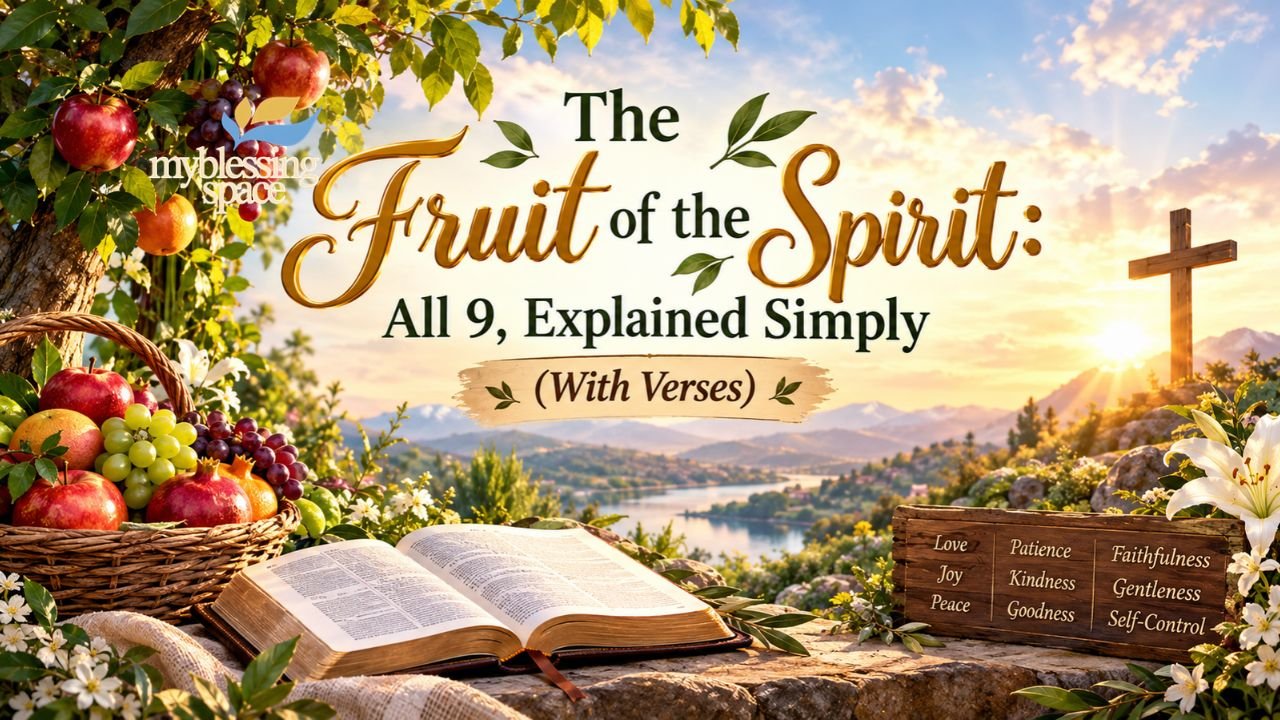
The Fruit of the Spirit: All 9, Explained Simply (With Verses)
🍎 An apple tree never strains, sets goals, or grunts to produce apples. It stays rooted, soaks up water and sunlight, and the fruit shows up in season. That small picture is the easiest way to understand the fruit of the Spirit, a phrase that leaves plenty of people scratching their heads the first time they hear it.
📖 The fruit of the Spirit is a list of nine character qualities the apostle Paul describes in Galatians 5:22-23: love, joy, peace, patience, kindness, goodness, faithfulness, gentleness, and self-control. Paul wasn’t handing out a to-do list. He was describing what a person’s life looks like when the Holy Spirit is steadily at work inside it. 🌱
💡 In this guide, you’ll get a plain-English explanation of the fruit of the Spirit, a closer look at the original Greek words behind each trait, everyday ways to practice them, Bible verses worth memorizing, and a clear answer to how the fruit of the Spirit differs from spiritual gifts. Every section is written so the fruit of the Spirit feels practical, not abstract. If you’ve ever felt like you’re failing at being “good enough,” keep reading. The good news is that the fruit of the Spirit isn’t built on willpower. 🙌
The Meaning of the Fruits of the Spirit
🧭 To grasp the fruit of the Spirit, it helps to know why Paul wrote about it. He was writing to churches in Galatia that were tangled in arguments about rules and who really belonged. Just before the famous list, he describes the “works of the flesh,” things like jealousy, fits of rage, selfish ambition, and division. Then he offers a striking contrast. Instead of a checklist of behaviors to fix, he points to the fruit of the Spirit, a way of life that grows from the inside out.
🍇 Notice that Paul uses the singular word “fruit,” not “fruits.” That small detail suggests the nine traits are one connected harvest rather than a menu where you pick your favorites. A person who is overflowing with joy but short on self-control, or strong in faithfulness but weak in gentleness, is simply still growing. The fruit of the Spirit develops together as someone stays close to Christ.
🏛️ Some historical background makes the passage richer. The Galatian believers were being pressured to add religious requirements on top of faith in Jesus, and the result was suspicion, comparison, and constant bickering. Paul’s answer wasn’t a longer rulebook. He told them to walk by the Spirit, and he promised that if they did, they wouldn’t be carried away by selfish cravings. That is a surprisingly freeing message for anyone who has felt exhausted by trying to be a better person through sheer effort.
⚖️ Paul closes the list with a quiet line: there is no law against such things. No government, rulebook, or religion could ever ban love or outlaw kindness. The fruit of the Spirit is exactly what the law was always pointing toward.
🪞 Jesus is the fullest picture of the fruit of the Spirit. Every trait on the list can be seen in the Gospels: His love for outcasts, His joy at a meal with friends, His peace asleep in a storm, His patience with slow-learning disciples. When Christians talk about becoming more like Jesus, they’re describing the long, gradual growth of the fruit of the Spirit. It’s character formed by following Him, not a personality type you either have or don’t.
🔄 Paul sets the fruit of the Spirit directly against the works of the flesh, and seeing the two side by side makes the contrast clear:
- 😡 Fits of rage give way to gentleness and self-control
- 😒 Jealousy and envy give way to love and joy
- ⚔️ Division and conflict give way to peace and patience
- 🪞 Selfish ambition gives way to kindness and goodness
- 🤥 Broken promises give way to faithfulness
🔎 If you enjoy word studies, a trusted Bible lexicon can show how each Greek term is used elsewhere in Scripture: about the original Greek words in Galatians 5:22-23.
Love

❤️ Love is a steady, self-giving commitment to seek another person’s good, modeled on the way God loves us.
🔤 The Greek word here is agape, which describes love that acts rather than merely feels. Jesus said the two greatest commandments are to love God and to love your neighbor (Matthew 22:37-39), and He told His disciples that people would recognize them by how they loved one another (John 13:35). That makes love the headline of the fruit of the Spirit and the soil where the other eight grow.
🤝 This kind of love is surprisingly practical. It looks like listening without checking your phone, forgiving the friend who keeps forgetting your birthday, and showing up with groceries when someone is sick. It doesn’t wait for people to deserve it, because God didn’t wait for us either. Romans 5:8 says Christ died for us while we were still sinners. As the Spirit works in you, the fruit of the Spirit called love starts reaching people you would normally avoid.
🏡 Picture a family dinner where an old argument is simmering under the table. Love doesn’t ignore the tension, but it refuses to win at someone else’s expense. It asks, “What does this person need right now?” and then acts on the answer. Over months, that single habit can change marriages, friendships, and workplaces. Because love sits first in the fruit of the Spirit, it’s a good place to start when you don’t know where to begin. Ask the Spirit to deepen your love, and watch how the rest of the fruit of the Spirit follows.
- 📱 Put your phone away during one conversation today and listen fully
- ✉️ Send an encouraging text to someone who has been on your mind
- 🙏 Pray for a person you find difficult, by name, for one full week
Joy
😊 Joy is a deep, lasting gladness rooted in who God is, not in how your day is going.
🔤 The Greek word chara is closely related to the word for grace, which hints at where joy comes from. It’s less a mood you manufacture and more a gift you receive. Paul wrote about rejoicing in his letter to the Philippians while he was in chains, which tells us the fruit of the Spirit doesn’t depend on easy circumstances. Happiness rises and falls with events. Joy can sit quietly beside sorrow.
🌤️ That doesn’t mean pretending everything is fine. Faith that is honest about pain can still hold gratitude, hope, and even laughter. Nehemiah 8:10 says the joy of the Lord is your strength, and Jesus told His disciples that He shared His own joy with them so theirs could be full (John 15:11). When the fruit of the Spirit grows in this area, you start noticing small gifts, like a good meal, a kind word, or a sunrise, and you feel thankful without needing a reason to be happy.
🏠 Think of the people you most enjoy being around. They aren’t always the loudest or the funniest. They’re the ones who carry a steady warmth into the room, even on hard days. That quiet gladness is a sign that the fruit of the Spirit is taking root. It also spreads: joy makes a kitchen table, a team meeting, or a church lobby feel safer. When the fruit of the Spirit called joy grows, gratitude becomes a habit and complaining loses its grip.
- 📝 Write down three small things you’re thankful for each evening this week
- 🎶 Play worship music during your commute or chores
- 🎉 Celebrate someone else’s good news out loud
Peace

🕊️ Peace is a calm, settled confidence in God that holds steady when life doesn’t.
🔤 The Greek word eirene carries the idea of wholeness, a sense that things have been put back together. It’s the word Jesus used when He said He leaves His peace with us, a peace unlike what the world offers (John 14:27). The world’s peace depends on quiet circumstances. The peace that belongs to the fruit of the Spirit shows up in the middle of a noisy news cycle, a tense family dinner, or a hospital waiting room.
🐦 Jesus pointed to the birds in Matthew 6 to make the point that the God who feeds them knows what you need. Paul adds in Philippians 4:6-7 that when we bring our worries to God with thanksgiving, His peace stands guard over our hearts and minds. Notice the order: prayer comes first, and peace follows. When the fruit of the Spirit called peace is growing, you may still feel concern, but you won’t be controlled by it.
🛋️ Imagine two people sitting in the same waiting room, both hearing the same difficult news. One spirals into worst-case scenarios. The other takes a breath, prays, and asks thoughtful questions. The difference isn’t personality. It’s where each person has placed their trust. The peace in the fruit of the Spirit doesn’t remove hardship, but it changes how you carry it. Over time, friends will notice that you’re the calm one in a crisis, which is a quiet testimony to the fruit of the Spirit at work in you.
- 🌬️ Take three slow breaths and pray one honest sentence the moment anxiety spikes
- 📵 Set a daily limit on news and social media scrolling
- 🧺 Write one worry on a note, hand it to God, and tuck the note in your Bible
Patience
⏳ Patience is the ability to stay steady and gracious under pressure, delay, and difficult people.
🔤 The Greek term makrothymia literally means “long-tempered,” the opposite of a short fuse. It describes endurance with people as much as with circumstances. The Bible uses the same idea to describe God Himself, who is slow to anger (Psalm 103:8). That’s good news, because it means the patience in the fruit of the Spirit isn’t gritted teeth. It’s borrowed from the One who has been patient with us.
🚦 Most of us practice patience in tiny ways: the slow checkout line, the toddler who refuses to put on shoes, the coworker who answers emails three days late. In those moments, the Spirit invites a pause between feeling and reacting. One helpful reminder is that you are not the center of the universe, and your timeline isn’t the only one that matters. God works at His own pace, and He is rarely late in the ways that count. Practicing the fruit of the Spirit here often begins with a simple breath and a short prayer.
👶 Parents, teachers, and caregivers know that patience is built through repetition. You answer the same question for the fifth time, wait for a slow learner, or sit through a long recovery. Those unglamorous stretches are where the fruit of the Spirit grows deepest, because patience can’t be rushed. Each time you choose a gentle response over a sharp one, you strengthen something that will serve you in every other relationship. The fruit of the Spirit isn’t cultivated in comfort. It’s cultivated in the waiting.
- ⏱️ Wait ten seconds before replying to a frustrating message
- 🛒 Choose the longest line on purpose once this week and use the time to pray
- 🌱 Pick one slow project, like a garden or a puzzle, and enjoy the process
Kindness
🤲 Kindness is gentle, practical goodwill that meets real needs with a generous heart.
🔤 The Greek word chrestotes describes someone gracious, useful, and good to be around. Paul uses it to describe how God treats us (Titus 3:4-5), and Ephesians 4:32 invites us to be kind to one another because God has been kind to us. Kindness takes patience a step further. Patience holds back the sharp word. Kindness offers a warm one.
🩺 Jesus modeled this constantly. In Mark 5, He was on His way to the home of a desperate father when a woman who had been sick for twelve years touched His cloak in the crowd. Jesus stopped, looked for her, and spoke to her with tenderness, even though an urgent need was waiting down the road. Kindness often looks like that: letting an interruption become a ministry. Whenever you allow the fruit of the Spirit called kindness to shape your schedule, people feel seen instead of handled.
🧑🤝🧑 Kindness is contagious, and it’s often small. A handwritten note, a ride to the airport, a meal left on a doorstep: none of these will make headlines, but each leaves a mark on someone’s day. The fruit of the Spirit isn’t limited to dramatic acts of courage. It’s built from thousands of ordinary gestures that say, “You matter to me.” If you want to see the fruit of the Spirit in your community, start by noticing who has been overlooked and doing one small thing for them.
- ☕ Buy a coffee or a meal for someone without telling anyone
- 👂 Ask a coworker how they’re really doing, then wait for the answer
- 🚗 Let someone merge ahead of you and smile about it
Gentleness
🌸 Gentleness is strength under control, a humble way of treating people with care and respect.
🔤 The Greek word prautes is sometimes translated as “meekness,” but it doesn’t mean weakness. It describes power that is held in check. Jesus called Himself gentle and humble in heart in Matthew 11:29, and He invited tired people to come to Him. If you want to see the fruit of the Spirit of gentleness in action, picture someone who has every right to be harsh and chooses to be tender instead.
🧸 Gentleness shows up in tone of voice, in the pace of a conversation, and in how we correct people. Galatians 6:1 even says to restore someone who has stumbled in a spirit of gentleness, and Proverbs 15:1 reminds us that a soft answer turns away anger. If you tend to be blunt, asking the Spirit to soften your delivery is a great place to practice the fruit of the Spirit. Gentleness also makes room for the shy, the grieving, and the newcomer, turning strangers into friends.
🛏️ Consider how a good nurse speaks to a frightened patient: slowly, warmly, with eye contact. That’s gentleness doing its work. At home, it can mean answering a teenager’s sullen silence with patience instead of a lecture. At work, it can mean giving feedback that corrects without crushing. Gentleness as part of the fruit of the Spirit doesn’t avoid hard conversations. It simply delivers them with respect, and people who experience that kind of care often open up in ways they never would under pressure.
- 🗣️ Lower your volume and slow your pace when a conversation gets tense
- 🤗 Greet the person who is standing alone at your next gathering
- ✍️ Re-read a hard email before sending it and soften one sentence
Goodness
🌟 Goodness is a steady commitment to do what is right and to seek the well-being of others.
🔤 The Greek word agathosyne points to moral excellence combined with generosity, goodness that moves into action. Acts 10:38 summarizes Jesus’ ministry by saying He went around doing good, and Galatians 6:9 encourages us not to grow weary of doing good. If kindness is warm goodwill, goodness is the backbone behind it: integrity that stays honest when no one is watching.
🧱 Goodness is also quietly countercultural. It means returning the extra change the cashier handed you, speaking up for the person being mocked, and refusing to cut corners on a project at work. Just as the fruit of the Spirit isn’t about being perfect, goodness isn’t about being holier-than-thou. It’s about lining up your everyday choices with the character of God, one small decision at a time.
🏪 Goodness shows up in the unglamorous details of daily life: how you treat a server, whether you keep your word on a small deal, what you do when you find a lost wallet. People rarely announce their goodness, and the fruit of the Spirit doesn’t ask for applause. When goodness grows, your private life and public life start to match. That integrity becomes a quiet anchor for the people who depend on you, and it points them toward the God who is good.
- 🧾 Be honest in a small situation where a lie would be easier
- 🛠️ Volunteer for a local need, such as a food pantry or neighborhood cleanup
- 🤫 Do one helpful thing today that nobody will ever know about
Faithfulness
🤝 Faithfulness is steady loyalty and dependability, rooted in trust in God’s own faithful character.
🔤 The Greek word pistis is usually translated as “faith,” but here it carries the sense of being reliable and trustworthy. Faithfulness is faith with legs. It shows up as keeping promises, finishing what you start, and staying loyal when the novelty fades. Luke 16:10 says whoever is faithful in small matters will be faithful in large ones, a good reminder that the fruit of the Spirit often grows in unnoticed corners.
🌧️ It also matters on the days when God feels quiet. Maybe a prayer went unanswered the way you hoped, or doubts crept in. Faith deepens the way any trust does: through time together, watching someone’s character, and taking small risks. Lamentations 3:22-23 says God’s faithfulness is great and His mercies are new every morning. When you pray, read Scripture, and trust Him with one new thing, you discover that He keeps showing up, which is exactly how the fruit of the Spirit called faithfulness grows.
🏗️ Faithfulness is the long game. It’s the spouse who keeps loving after the honeymoon fades, the employee who works with integrity when the boss isn’t looking, and the friend who answers the phone at midnight. Nobody gets noticed for being faithful for a single day, but over years it builds a trust that nothing else can replace. The fruit of the Spirit called faithfulness grows by repeating small acts of loyalty until they become the shape of your life.
- 📅 Set one small, repeatable habit with God, like five minutes of Scripture each morning
- 📞 Keep a promise you’ve been putting off, even a small one
- 🔍 Look back at a time God came through for you and write it down
Self-Control
🛡️ Self-control is the Spirit-empowered ability to guide your desires and impulses instead of being ruled by them.
🔤 The Greek word enkrateia means mastery over oneself. Everyone needs it, because everyone faces temptation, whether that’s a short temper, endless scrolling, overspending, gossip, or the third slice of cake. It’s easy to see how self-control protects the other eight, since patience, kindness, and faithfulness all collapse without it. Proverbs 25:28 compares a person without self-control to a city with broken-down walls.
🏜️ Jesus gives us a picture of the alternative. In the wilderness (Matthew 4), He was hungry and worn out, and He was offered shortcuts. He said no because He was anchored in His purpose and in the Father’s word. We can do the same by remembering what we’re living for. Second Timothy 1:7 says God gave us a spirit not of fear but of power, love, and self-discipline. So the fruit of the Spirit called self-control isn’t about gritting your teeth. It’s about leaning on the Spirit when your own strength runs out.
🧗 Self-control gets a bad reputation because people associate it with saying no all the time. In reality, it’s about saying yes to what matters most. When you hold back the harsh comment, close the laptop, or walk away from the argument, you’re protecting something valuable. The fruit of the Spirit of self-control is less like a cage and more like a trellis that gives a growing plant its structure. With the Spirit’s help, small victories build momentum, and the fruit of the Spirit becomes visible in places where you once felt stuck.
- 🕰️ Pick one habit to pause for 24 hours and pray whenever the urge hits
- 📵 Put your phone in another room during meals or prayer time
- 🧠 Memorize one short verse to repeat when temptation shows up
Bible Verses About the Fruit of the Spirit

📚 Scripture gives the fruit of the Spirit its roots, and these Bible verses about the fruit of the Spirit make memorizing it easier. Two verses for each trait are listed below, paraphrased in plain language so they’re easy to remember and pray. Try picking one verse per week, and you’ll have worked through the whole harvest of the fruit of the Spirit in about two months. 🗓️
- ❤️ 1 Corinthians 13:4-7 describes love as patient and kind, free of envy, and unwilling to keep a record of wrongs.
- 🌍 John 13:34-35 records Jesus telling His followers to love one another as He loved them, so the world will know they belong to Him.
- 🌅 Psalm 16:11 says that in God’s presence there is fullness of joy.
- 💪 Nehemiah 8:10 declares that the joy of the Lord is a source of strength.
- 🕊️ John 14:27 has Jesus offering a peace the world can neither give nor take away.
- 🛡️ Philippians 4:6-7 promises that praying with thanksgiving brings a peace that guards the heart and mind.
- ⏳ Romans 12:12 urges believers to be joyful in hope, patient in trouble, and faithful in prayer.
- 🎣 Psalm 40:1 describes waiting patiently for the Lord and finding that He leans in to listen.
- 🤲 Ephesians 4:32 invites us to be kind and tenderhearted, forgiving each other as God forgave us in Christ.
- 💬 Proverbs 11:17 observes that a kind person ends up benefiting their own soul.
- 🌸 Proverbs 15:1 says a gentle answer calms anger, while harsh words stir it up.
- 🙌 Galatians 6:1 says to restore a friend who has stumbled with gentleness, while watching your own heart.
- 🌟 Galatians 6:9 encourages us not to tire of doing good, because a harvest arrives in due time.
- 🧭 Micah 6:8 sums up goodness as acting justly, loving mercy, and walking humbly with God.
- 🌄 Lamentations 3:22-23 says God’s mercies are new every morning and His faithfulness is great.
- 📦 Luke 16:10 teaches that being faithful in little things shows up in big things too.
- 🏰 Proverbs 25:28 compares someone without self-control to a city with broken walls.
- 🔥 2 Timothy 1:7 says God gave us a spirit of power, love, and self-discipline rather than fear.
How to Memorize Bible Verses About the Fruit of the Spirit
🧠 Memorizing Scripture sounds intimidating, but it works best in small, repeatable steps. Start with the verse that matches the trait you most need right now, and let it become a short prayer throughout your day. Over time, those verses surface in the exact moments you need them, especially the ones about the fruit of the Spirit that keep you from reacting in anger or fear.
- ✍️ Write the verse on a sticky note and place it where you’ll see it
- 🎧 Record yourself reading it and listen during your commute
- 🗣️ Say it aloud each morning for one week
- 🤝 Share it with a friend and quiz each other
- 🙏 Turn it into a one-sentence prayer
The Fruit of the Spirit vs. the Gifts of the Spirit: What’s the Difference?
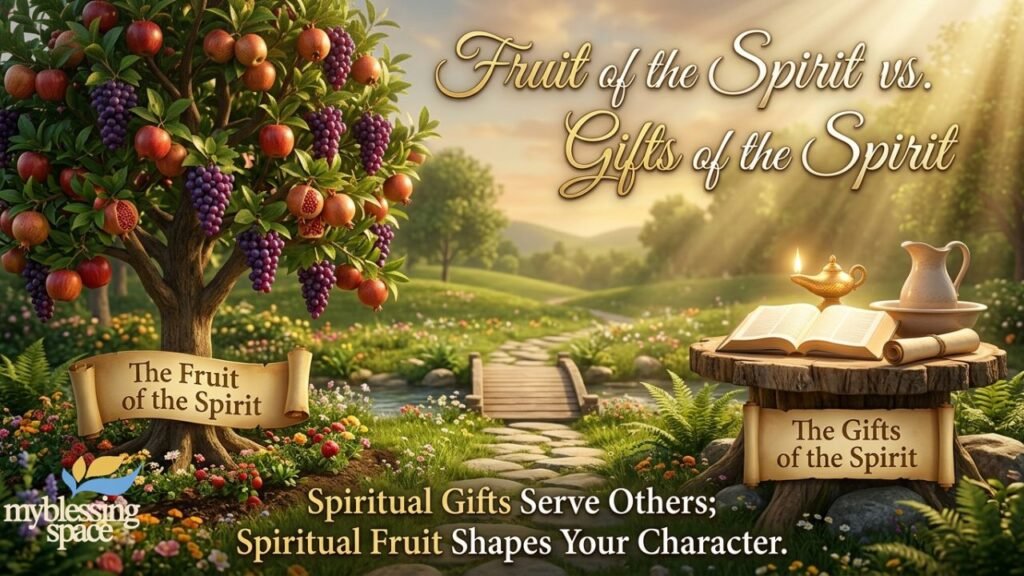
🤔 People often mix these up, and it’s easy to see why. Both come from the same Spirit, and both appear in the New Testament. Still, the fruit of the Spirit and the gifts of the Spirit do very different jobs. The gifts are abilities, such as teaching, serving, giving, leading, showing mercy, or encouraging others (Romans 12:6-8 and 1 Corinthians 12). The fruit is character, the kind of person you become. One is about what you can do. The other is about who you are.
🎁 A helpful way to remember it: gifts are handed out in different amounts, while the fruit of the Spirit is meant to grow in every believer. Here is how the two compare:
- 🍎 Fruit is character; gifts are abilities. Love and patience belong to the fruit of the Spirit and describe who you are, while teaching and hospitality describe what you do.
- 🌳 Fruit is one harvest; gifts are many. Paul uses the singular for the fruit of the Spirit and the plural for gifts.
- 👥 Fruit is for every believer; gifts are distributed differently. First Corinthians 12:11 says the Spirit gives gifts as He chooses.
- 🌱 Fruit grows over time; gifts are given for service. The fruit of the Spirit ripens slowly, while gifts are given to help others (1 Corinthians 12:7), so the fruit of the Spirit shows your character over time.
- ♾️ Fruit lasts forever. Paul says love never fails, while some gifts will eventually pass away (1 Corinthians 13:8).
🧑🏫 Think of a talented teacher. The gift of teaching helps her explain a hard idea clearly, but the character she brings to the classroom decides whether students feel safe enough to ask questions. Patience, kindness, and gentleness turn a skill into a blessing. The same goes for musicians, leaders, and volunteers. Skill gets attention, but character earns trust, and trust is what makes service last.
💛 The two work best together. Paul warns in 1 Corinthians 13:1-3 that even the most impressive gifts amount to little more than noise without love, the first quality in the fruit of the Spirit. A talented speaker with no gentleness can wound people, and a gifted leader with no self-control can burn out a team. The fruit of the Spirit is what keeps gifts healthy, humble, and useful.
Signs the Fruit of the Spirit Is Growing in You
🔍 Growth in the fruit of the Spirit is usually quiet. You may not feel different, but the people around you might notice. Watch for signs like these:
- 🌤️ You recover from frustration faster than you used to
- 🤝 You apologize sooner and hold grudges less
- 🧘 Worry still shows up, but it doesn’t run your day
- 👂 You listen more and interrupt less
- 🎁 Generosity feels natural instead of forced
- 🗓️ You keep commitments even when they’re inconvenient
- 😊 Gratitude pops up in ordinary moments
- 🛑 You say no to temptations that once felt impossible to resist
🌱 Don’t be discouraged if you only see a few of these. Small growth counts. The fruit of the Spirit isn’t a competition or a scoreboard, and God delights in progress long before perfection.
How Do I Grow the Fruit of the Spirit?

🌿 These are the fruit of the Spirit, not the fruit of hard work and effort. If growing in all nine feels like too much, that’s actually a hopeful sign that you’ve understood the point. Jesus used the picture of a vine in John 15, saying that branches bear fruit by staying connected to Him, and that apart from Him we can do nothing. A branch doesn’t produce grapes by trying harder. It produces them by staying attached.
🔑 So the goal isn’t to tackle nine projects. It’s to remain close to Jesus and let the Spirit do the growing. Paul put it simply in Galatians 5:25: since we live by the Spirit, let’s keep in step with the Spirit. As you give Him more room in your daily life, the fruit of the Spirit shows up in ways you didn’t plan, and often in ways other people notice before you do. 🌻
🗺️ Also read: bible verses about falling leaves
- 📖 Read Scripture daily. Even ten minutes with a Gospel helps you notice the character of Jesus, which is the pattern for the fruit of the Spirit, and it gives the Spirit something to work with.
- 🙏 Pray honestly. Tell God where you’re impatient, anxious, or tempted, and ask the Spirit to grow what’s missing in the fruit of the Spirit.
- 🎵 Worship regularly. Singing, gratitude, and praise keep your heart soft, which is the kind of soil where the fruit of the Spirit grows best.
- 👥 Stay in community. Friends who love Jesus will encourage you, notice growth in the fruit of the Spirit that you can’t see, and gently call out blind spots.
- 🤲 Serve someone. Love, kindness, and goodness grow fastest when the fruit of the Spirit is practiced on real people.
- 🧹 Confess quickly. When you fall short, naming it and receiving forgiveness keeps the soil of your heart healthy.
- 🛌 Rest. Slowing down, including a weekly Sabbath, makes room for the fruit of the Spirit, especially peace and self-control, to take root.
- 📓 Journal your growth. Looking back over months reveals how much the fruit of the Spirit has been ripening, even when it felt slow.
🚧 Almost everyone hits obstacles along the way. A packed schedule crowds out quiet time. Old habits pull you back. Comparing yourself to someone who seems further along makes you feel behind. These are normal, and none of them cancel the work the Spirit is doing. When you stumble, confess it, receive forgiveness, and begin again. Growth in the fruit of the Spirit is rarely a straight line. It’s more like a hillside path with a few switchbacks, and you’re still heading up.
⏳ Be patient with the process. Fruit takes seasons, not days, and some seasons will feel more like pruning than harvest. Jesus said the Father prunes branches so they will bear more fruit (John 15:2). If you’re going through a hard stretch, it may be the Spirit preparing a new level of growth in the fruit of the Spirit.
Frequently Asked Questions About the Fruit of the Spirit
What is the fruit of the Spirit?
🍇 The fruit of the Spirit is a set of nine qualities that appear in a person’s life when the Holy Spirit is at work: love, joy, peace, patience, kindness, goodness, faithfulness, gentleness, and self-control. They reflect the character of Jesus and show up gradually as someone follows Him. In other words, the fruit of the Spirit is the Spirit’s work in you, not your own achievement.
Where is the fruit of the Spirit in the Bible?
📖 You’ll find the fruit of the Spirit in Galatians 5:22-23. It’s part of a letter Paul wrote to early Christians, urging them to live by the Spirit instead of by selfish desires and constant conflict. The fruit of the Spirit appears in a short list that has influenced Christian teaching for centuries.
What are the 9 fruits of the Spirit?
🔢 The nine are love, joy, peace, patience, kindness, goodness, faithfulness, gentleness, and self-control. Together, they make up the fruit of the Spirit. Each reflects a part of God’s nature, and each grows as we follow Jesus.
How do I grow in the fruit of the Spirit?
🌱 Growth happens over time as you spend time with God, read the Bible, pray, serve others, and let the Spirit guide your choices each day. Think of it as staying connected to the vine rather than working harder, and remember that the fruit of the Spirit always grows from that connection. The fruit of the Spirit is something God grows in you, not something you earn, and the fruit of the Spirit ripens at different speeds for different people.
Is the fruit of the Spirit for every Christian?
🙌 Yes. The fruit of the Spirit isn’t reserved for pastors or “super spiritual” people. It’s for everyone who follows Jesus, and it’s how God slowly shapes ordinary people to look more like Him. Whether you’ve followed Jesus for fifty years or five days, the fruit of the Spirit is available to you.
Why is it “fruit” and not “fruits”?
🍎 Paul uses the singular word “fruit,” which suggests the nine traits belong together as one harvest. People do sometimes say “fruits of the Spirit” in everyday conversation, and that’s fine, but the singular reminds us that the fruit of the Spirit grows as a whole instead of one trait at a time.
What is the difference between the fruit of the Spirit and the gifts of the Spirit?
🎁 The fruit of the Spirit describes character, such as love and patience, and is meant to grow in every believer. Spiritual gifts are abilities given for service, like teaching or showing mercy, and they differ from person to person. The fruit of the Spirit keeps those gifts loving and humble.
What are the works of the flesh that oppose the fruit of the Spirit?
⚠️ Galatians 5:19-21 lists them, including sexual immorality, idolatry, hatred, jealousy, fits of rage, selfish ambition, and drunkenness. They show what life looks like when we follow our own impulses, which is exactly the contrast Paul draws with the fruit of the Spirit.
Conclusion
🌈 The fruit of the Spirit isn’t a standard you have to meet to earn God’s approval. It’s a picture of what happens when a life stays close to Jesus: love that reaches, joy that lasts, peace that holds, and four more qualities that quietly reshape how you treat people. You don’t have to master all nine parts of the fruit of the Spirit this week. You only have to stay connected and take the next small step.
🌟 Pick one part of the fruit of the Spirit that feels most needed right now, try one practice from this guide, and ask the Spirit to do what you can’t do on your own. Over time, people around you will notice something different about the way you love, speak, and wait. That is the fruit of the Spirit at work, and it’s one of the most beautiful things a life can produce. 🍎
🙏 Holy Spirit, grow the fruit of the Spirit in me. Where I’m impatient, teach me to wait. Where I’m harsh, make me gentle. Where I’m tired, fill me with joy and peace. Help me remain in Jesus, and let Your fruit show in the way I love others today. Amen.

Hi, I’m Emily Grace.I write to share blessings, kind words, and gentle reminders of hope. I believe that even a few sincere lines can bring comfort, peace, and positivity into someone’s day. Through my writing, I aim to inspire gratitude, faith, and calm in everyday life. My hope is that these words feel like a quiet moment of light whenever you need it most.